Research
My Research
1. Investigating Craton Dynamics and Ore Deposit Formation for Sustainable Critical Minerals Supply
- Duration: August 2024 to present
- With: Prof. Jeroen van Hunen and other EarthSafe collaborators
Details coming soon.
2. Conversion of shear wave velocity to temperature
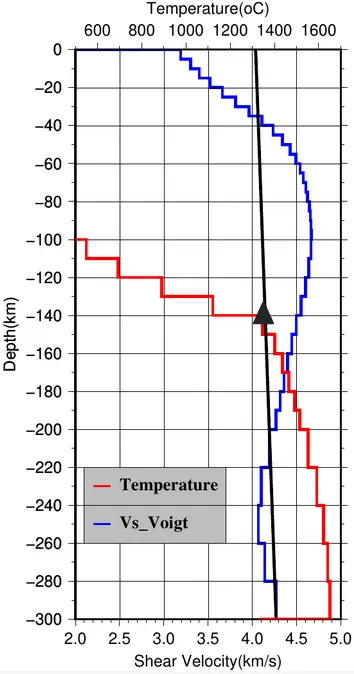
As a side project of my Master’s thesis, I converted my shear wave velocity model to temperature using two methods: the empirical relation of Priestley et al. (2006), and the Litmod approach of Kumar et al. (2020), which calculates material properties at a range of P–T conditions and compares them to observations. Both methods give similar results, yielding a lithosphere thickness model across India and Tibet.
Right: conversion of shear wave velocity to temperature for a single node.
3. Joint anisotropic inversion of Love and Rayleigh wave dispersion
- With: Prof. Supriyo Mitra, IISER Kolkata
We jointly inverted Love and Rayleigh wave surface wave dispersion curves across Tibet, the Himalayas, and central India to obtain an anisotropic shear wave velocity structure. This work aims to:
- Provide a detailed shear wave velocity structure of the Indian lithosphere beneath Tibet
- Reveal deformation from past tectonic processes through radial anisotropy
- Reduce the discrepancy between Love and Rayleigh waves in an anisotropic medium
Publications and conference presentations
- Chakraborty, A., Ghosh, M., Dey, S., Sharma, S., Bhattacharya, S. N., and Mitra, S.: Deformation of the Indian Lithosphere from radial anisotropy: Signatures of laterally varying plate geometry beneath Tibet and hotspot volcanism beneath the Deccan Plateau, EGU General Assembly 2024, Vienna, Austria, 14–19 Apr 2024, EGU24-17055, https://doi.org/10.5194/egusphere-egu24-17055
- Ghosh, M., Chakraborty, A., Dey, S., Kharjana, I., Sharma, S., Bhattacharya, S. N., and Mitra, S.: Radially anisotropic shear-wave velocity structure of northern India, Himalaya and Tibet, EGU General Assembly 2023, Vienna, Austria, 24–28 Apr 2023, EGU23-11721, https://doi.org/10.5194/egusphere-egu23-11721
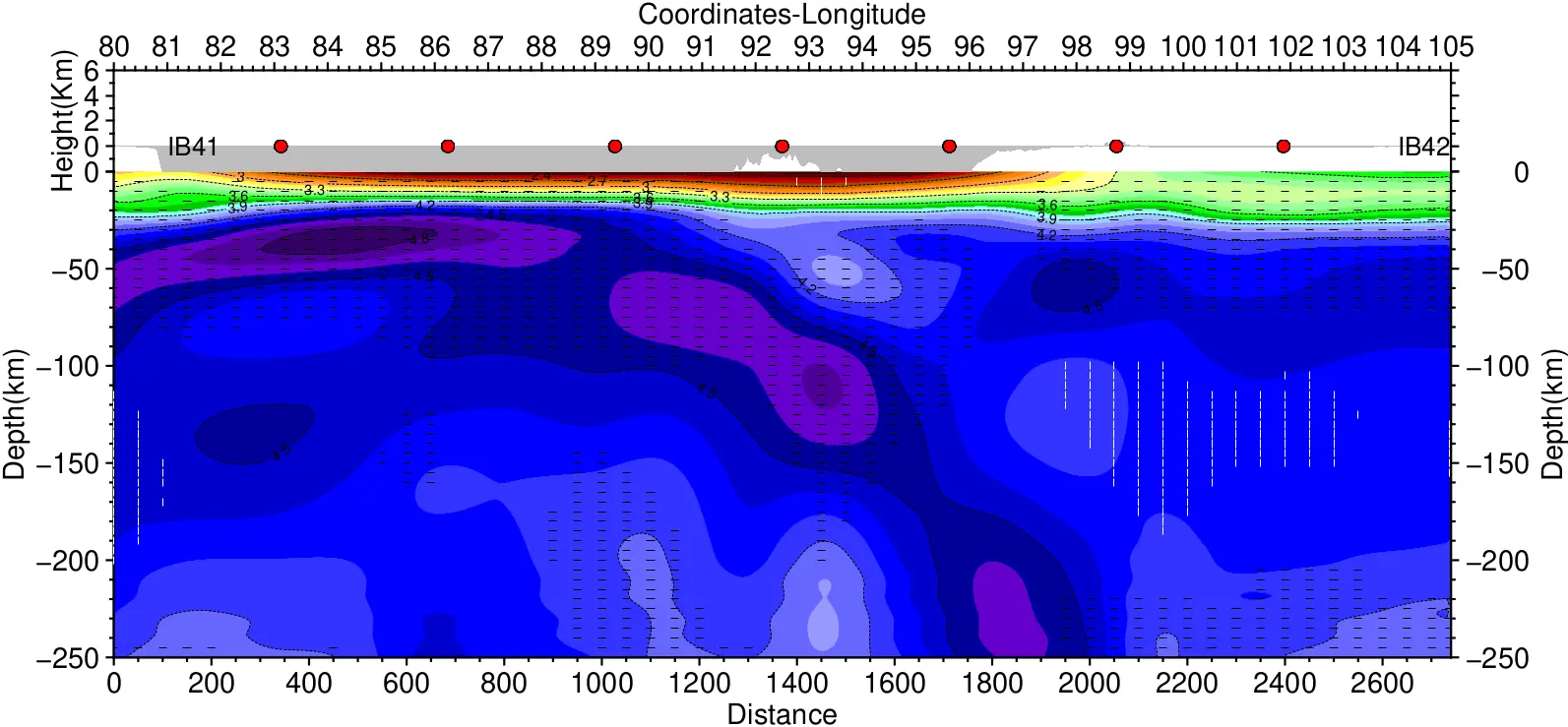
A cross-section of the downgoing Indian plate under the Indo-Burma subduction zone. The mantle wedge shows negative anisotropy (indicated by white lines).
4. GPE evolution from 150 Mya to present day
- Duration: May 2022 to July 2022
- With: Dr. Attreyee Ghosh, IISc Bengaluru
The initial objective was to study variation of temperature in oceanic lithosphere with age and construct a lithospheric thickness map for oceanic plates — first for present-day age grids, then from 200 Myr to the present. I then applied crustal thickness and topography data from CRUST1.0 and ETOPO1 to calculate present-day gravitational potential energy (GPE), and studied its evolution from 250 Mya to the present using a paleo-topographic dataset [Scotese, 2021].
Evolution of GPE from 150 million years ago to the present day.